Week 6: Creating Metadata and Selecting Tagging Systems

With the goals of the Southern California Library in mind, the metadata process was largely based on accessibility. The question which underpinned the choices when it came to metadata like subject terms and description was: How can I make this “findable” for both researchers and community members?

1.) Because most of the objects I dealt with clearly provided information like the title, creator, contributor and date(s), there was little trace of my hand in these matters. However, for metadata like, the subject terms and description, I felt a great responsibility to accurately represent the object and to provide comprehensive information not covered by the title, creator, contributor and dates. For this reason, I employed a method in which I first identified and listed the title, author(s), and the date of an object before moving forward. If I ran into any problems with these fields I left them blank to be discussed at a later time with the class. After I located the initial metadata, I began collecting information for the description. To go about this with shorter documents, I read them in their entirety then identified the function, purpose, or goal of the document and any predominant themes. In the case of periodicals, article titles were particularly helpful for gauging the scope of the material. In order to craft a description for the more lengthly documents, I depended on the table of contents to identify some key topics and  then craft a description. However, in the case of the McCone report I found the section titles like, “The Crisis – An Overview” and “144 Hours in August 1965,” cryptic and sensational so if I came upon an issue like this, I spent enough time in each section of the document to identify the main points and important themes. After the description was completed, I moved on to the subject terms. Using the information I gained in crafting the description I began by using very general terms like “housing” and “law enforcement” alongside more specific terms like “Rumford Fair Housing Act” and “Workers Union,” (this is something that would change after I workshopped my subject terms with the class). Most often, I chose subject terms directly from the vocabulary used in the material.
After I completed the input of the metadata on my own, we reviewed our choices as a class and identified changes that needed to be made, subject terms which functioned well (or did not function well), and addressed material with missing metadata or with metadata that we were unsure of. This last step of the process was particularly helpful; to see the choices others made with subject terms allowed us to work as a group to shape a cohesive vocabulary of search terms. Personally, the group workshopping helped me narrow down my subject terms into more specific and useful metadata. For instance, instead of including both general terms and specific vocabulary, I found that the more specific subject terms were much more useful and functioned to fill any gaps that were left by the other metadata fields. For this reason I feel confident that my choice of subject terms will make the objects available and findable for many audiences. 

The most difficult part of the process was negotiating with my feelings of inadequacy. As a graduate student in English Literature I am inclined to research a text quite thoroughly before I make any claims about it. Therefore, it was difficult for me to create metadata for these objects when I did not feel like an expert in the field. While I read the material and spent a good amount of time with it, I still struggled with the fact that I am not a specialist when it comes to Watts, nor am I a librarian who is well-practiced in assigning metadata. However, many of our readings for the class were helpful in providing historical information about Watts as well as theoretical practices when it comes to approaching archives and digital space. For instance, Gerald Horne’s Fire Next Time provided necessary historical information about Watts 1965 and even named and contextualized some of the material we digitized (ie. the McCone Report) and newspaper clippings (ie. The LA Times article “1,000 Riot in LA) we came across in our research. Theoretically, the Ta-Nehisi Coates novel Between the World and Me was great for approaching and understanding the socio-political, racial, and colonial power struggles over the black body in America. While as a female I must guard and protect my body in ways a male will never know, Coates’ text made it palpable just how different my experience is from Coates’ and that of the Black American male. In this way, Coates’ text highlighted the problematic role I played in the digitizing of materials pertaining to a history that is not my own. However, while I do believe the constant interrogation of my role in this project is unquestionably necessary, I do not feel it was counter-productive and I am confident in saying that I did my best to serve the needs of the Southern California Library.

2.) According to Gene Smith in his book, Tagging: People Powered Metadata for the Social Web, tags are “keywords added by users” which “can be descriptions of the resources subject matter, its location, its intended use, a reminder, or something else entirely” (14). He goes on to say that “different people have different tagging patterns. . . Tagging systems allow for — and even encourage — these differences” (14). In other words, tagging is information about an object provided by the community. The benefits of tagging are numerous. For one, tagging allows for a collaborative understanding of an object which reaches many audiences. Second, as an information organization system, tagging allows an object, as Smith says, “to be in two, three, or more ‘places’ at once” (27). Thanks to tagging, a digital object is not bound to its standard metadata like Library of Congress subject terms. Instead, a digital object can be found by other, oftentimes more accessible, subject terms provided by the community. While a downfall of tagging is that its idiosyncratic nature is difficult to track, for the purposes of the Southern California Library, tagging is a great way to make information accessible to the community and to engage the community with the materials. 
There are many different tagging systems; some websites have an ‘anything goes’ method when it comes to tagging while others have a more controlled system in which users may choose from preset tags. In order for the tagging system on this particular project to be successful, I would suggest a tagging system that falls somewhere in between. The most functional system might be one that mirrors the example of Etsy, which Gene Smith references in his article, “Tagging: Emerging Trends.” Etsy gives the user the option to chose from prescribed tags as well as the option to create his or her own tags: “Etsy’s pre-defined tags form the top-level category navigation on the website. The suggested tags are actually sub-categories for each of the main categories. While users are nudged toward these suggested tags, they can still enter their own tags” (16). With this method, Smith claims that Etsy can maintain a “fairly stable navigation system that remains responsive to the needs of users” (16). Simply offering the ability to tag is meaningless unless the tagging system actually works to make material more accessible and easier to find. Including suggested tags will eliminate the chaos of a pure user-based vocabulary, yet users will still have the option to provide their own tags which will fill any gaps left by the pre-defined tags. This way the material will be accessible through both the preset tags and the tags users develop, optimizing an objects circulation and find-ability. Implementing this kind of tagging system for the resources digitized for the Southern California Library would be best for serving the mission of the library: “to document and make accessible histories of struggles that challenge racism and other systems of oppression so we can all imagine and sustain possibilities for freedom” (emphasis added by me).  
Week 5: The Ethics of Metadata

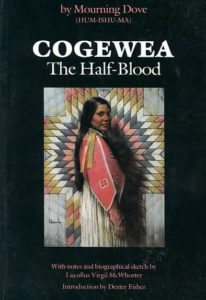
The importance of ethics when undertaking the responsibility of classification cannot be overstated. In considering this responsibility I am reminded of research I did on Native American author, Mourning Dove and her novel Cogewea: The Half Blood. At one point Mourning Dove was considered the first Native American Woman author, however, much of the scholarship revolving around her and her novel is centered on a man named Lucullus McWhorter. McWhorter was an anthropologist interested in Native American culture and history. He met Mourning Dove at a local event and the two developed a correspondence about her writing and McWhorter later became the editor of her novel. However, the two had different ideas about the story her novel would tell. While Mourning Dove had the intentions of writing a “western romance,” McWhorter was intent on selling the novel as a text about the Native American experience. Against her will, McWhorter pushed an “authentic looking” Native American depiction of Mourning Dove on the cover, added epitaphs before each chapter, and more. In all my research on the text , I would say the most frequently cited quote is Mourning Dove’s statement in a letter to McWhorter:

“I felt like it was some one else’s book and not mine at all. In fact, the finishing touches are put there by you, and I have never seen it.”

Some critics believe that McWhorter’s role in the processing, packaging and even the content of Mourning Dove’s novel was so large that Mourning Dove’s authorship is invalidated. What is most upsetting is not that McWhorter’s agenda is so apparent in Mourning Dove’s novel but is that Mourning Dove’s text has not received the critical attention it deserves or reached the audience it intended because the discourse is so focused on McWhorter. McWhorter injected himself into Mourning Dove’s text and to this day that is the only narrative in circulation. 

    Cogewea

I have included this story because it is a cautionary tale of what not to do. While McWhorter’s role was editor and not someone who implemented a digital classification system, one can read his choice of picture on the cover of the text as a title, and his epitaph’s as a form of metadata. In fact, it is important to note that McWhorter, as an anthropologist, most likely had a scholarly audience in mind, as opposed to Mourning Dove, who was interested in writing a western romance. Thus, As students working with metadata for documents and materials pertaining to the Watts Rebellion, it is impossible to know the full story behind each document, but it is our responsibility to not only make these documents available via the most ethical classification system but also, in doing so, to honor the history of the community and the requests of the Southern California Library. 

One of the most challenging parts of this project will be keeping audience in mind. In order for this to be done ethically, these materials must be accessible to both scholarly researchers and members of the community. One way I can imagine functioning is by balancing tags and metadata heavy with academic or governmental jargon with appropriate synonyms. The other challenging aspect will be representing the materials accurately. My answer to the question of whether or not we can represent these materials accurately is: I’m not sure. As an academic I want to be an extremely well researched on a topic before I make any public claims about it. Thus, my inclination in representing these materials via metadata and tagging is to approach it like I would writing a seminar paper: research, research research. However, becoming an expert on each document is simply not possible given the reasonable time constraints, yet, this is an issue I still struggle with. 

A question I am left with is this: When it comes to metadata and tagging, is it better to take a minimalist approach or to include a large amount of metadata, which risks creating a narrative for an object before a user has read the material themselves? 

Week 4: The Women of Watts

Reflecting on the absence of women in the Watts documentary made me think of the voices of Wanda Coleman and Betty Pleasant – the women who have spoken out about the Watts rebellion. 
Much of the discourse surrounding the Watts rebellion is wrought with gendered terminology which is undoubtedly, exclusively male. For instance, in Betty Pleasant’s article, “‘Baby’ I Dodged Bullets While L.A. Burned” she speaks of “hard core rioters who were willing to die for the cause of the black brotherhood” (emphasis mine). The focus certainly did seem to be on the “brotherhood” as Pleasant frequently referred to participants as “the guys”. She even goes so far as to call it “Viet Watts,” likening it to war; specifically a war fought predominantly, if not exclusively, by men. Perhaps this emphasis on hyper-masculinity is one of the reasons Pleasant’s article is written with such separatism and conviction. I imagine that as a woman, it would be difficult to feel included in a movement of an oppressed community raising up against systemic racial injustices so heavily saturated with and centered around fraternal camaraderie, or the “brotherhood”.
Maybe this is the same reason Wanda Coleman states that despite the voices of, “James Baldwin, Richard Wright, and W. E. B. Du Bois . . . The hero I longed for did not seem to exist.” Coleman is right to mention this disparity. While James Baldwin and Ta-Nehisi Coates have been powerful voices for the black identity, both of their works are fueled by a paternal, and distinctly fraternal, individualism. For instance, in all his talk about “black bodies,” Coates only gives, periodically, a brief nod to the black female body: “the women around you must be responsible for their bodies in a way that you never will know.” While he is right to say that his son, a male, will not even truly “know” the ways in which women must protect and guard their bodies, he leaves it at that and does not attempt to go any further. It is troubling that Coates’ book, which sets out to encompass the black experience and is often hailed for doing so, leaves such a glaring gap when it comes to the experience of the black female. 

Week 4: Social Media as Digital Platform for Academics

1. It is difficult for me to conceive of Twitter as a place for meaningful academic work mainly because of my issues with fragmentation, character limits, and difficulty in readability (it’s simply hard to follow). In this way, the forum inevitably causes conversation, brainstorming, workshopping, and feedback to be brief and most of all, as Dr. Ryan said, ephemeral. Where I do see potential in Twitter, is in the promotion of other forums, articles, or blogs. Twitter is a great place to share a link of an article or blog post to an audience of people in your field who may be interested. For instance, if I was to come across some interesting artifact relating to Wendy Coleman at the Southern California Library, and were to digitize it, this would be a fantastic digital piece to share via Twitter with a professor at UPENN I heard present on Wendy Coleman’s poetry last year. In fact, Twitter could be a great place to share links to what we do end up digitizing from the Southern California Library with other Scholars interested in Watts, as well as with community members in South Central LA. The accessibility of Twitter is open to everyone and it’s a platform that reaches beyond academia, which serves to reach larger audiences. Because the this digital archiving project already has the aim of accessibility and the goal of making information available – Twitter might be a great way of getting that information out there. 

2. The Twitter feed from #HILT2015 is demonstrating the potential to share useful information with other academics. For instance, one user referenced a “conversation about asking applicants to submit gender info” and then shared a link to an article titled, “New Categories Are Not Enough: Rethinking the Measurement of Sex and Gender in Social Surveys.” Another user posted a link to her article in “Inside Higher Ed” titled “Reflections of #HILT2015”. By sharing these articles, academics are able to keep a conversation going on a topic previously discussed in a class, conference, or other academic setting. Outside of sharing articles, one user posted a Word Cloud of William Byrd II’s “Virginia Diaries”. Sharing a Word Cloud via twitter is great because it is a fun, visual means of digital scholarship which is easy to evaluate and discuss. While these are only a few examples out of many, they demonstrate useful ways of sharing information on Twitter to those who either attended the course, or are interested in learning more about the subject.

3. Some sources on DH and Race/The “Digital Divide”: 
Richard Ohmann, “Literacy, Technology, and Monopoly Capital” 
Selfe, Cynthia L., and Richard J. Selfe, “The Politics of the Interface: Power and Its Exercise in Electronic Contact Zones” 
Moran Charles, and Cynthia L. Selfe, “Teaching English across the Technology/Wealth Gap” 


Week 2: Teaching Bias in Technology

The illusion of neutrality and machine-like objectivity are definitely understandings which permeate the use of technology. However, our discussion of the prejudice enmeshed with the algorithms in search engines like Google was something that made perfect sense to me. I don’t know a lot about algorithms or the way search engines function, but Dr. Noble’s explanation of “the man behind the curtain” was certainly easy enough for me to understand and sequentially evaluate. Therefore, I am under the impression that the difficulty in teaching bias in Google to undergraduates may be overestimated.

That being said, I was also reminded of the first time I came across scholarly work on the fact that technology is not neutral in Theory of Teaching, a mixed class of undergraduates and graduates, where we read Cynthia L. Selfe and Richard J. Selfe, Jr.’s 1994 article “The Politics of the Interface: Power and Its Exercise in Electronic Contact Zones”.  Cynthia L. Selfe and Richard J. Selfe, Jr. argue that computer interfaces create and perpetuate divides within society. They write:

The rhetoric of technology obscures the fact that, within our current educational system — even though computers are associated with the potential for great reform — they are not necessarily serving democratic ends. Computer interfaces, for example, are also sites within which the ideological and material legacies of racism, sexism, and colonialism are continuously written and re-written along with more positive cultural legacies (743). 

They go on to say that part of the way that interfaces, “order the virtual world according to a certain set of historical and social values that make up our culture,” is because of the fact that they have “grown out of the predominately male, white, middle-class, professional cultures associated with the military-industrial complex” (Selfe 745). The interfaces, as Cynthia and Richard Selfe have identified, reflect this demographic. They give examples of the terminology associated with modern capitalism and “white-collar inhabitants” of corporate culture such as “desktop,” “files,” “documents,” etc. They argue that the use of these terms to identify functions of the computer are a distinct reflection of the powerful ideology capitalism values and perpetuates.

For me, the author’s arguments were generally convincing, and impactful but I took issue with their suggestion that a “domestic” interface may better serve “women in the home” (746). However, the undergraduate students in the class were not persuaded at all, and openly laughed off the authors’ critique of the “the white pointer hand . . .  ubiquitous in the Macintosh primary interface.” The students couldn’t seem to get past the dated nature of the article in conjunction with some of the examples, and missed the important message. This instance is representative of the major difficulty in asking undergraduates to be critical of, and take seriously, the racial, and/or gender bias and capitalistic imperatives wrapped up in in technology. 

It’s possible that, because it is dated, the Selfe article isn’t the best way to get the message of biased technology across to younger students. I think the key is to stay very current, and to use live examples that hit home for students. For instance, Dr. Noble’s example of typing the word “beautiful” into Google images and the results being singularly white women is unquestionably problematic. Alternatively, spending class time examining search suggestions, like the ones in Dr. Noble’s presentation, would be equally impactful. 

While I wouldn’t use it to teach undergraduates, the takeaway from the Selfe article, that instructors must actively take every opportunity to teach their students and their colleagues to be critical of technology, is incredibly important and something for all instructors to follow: “We have to educate them to be technology critics as well as technology users. This recognition requires that composition teachers acquire the intellectual habits of reflecting on and discussing the cultural and ideological characteristics of technology — and the implications of these characteristics — in educational contexts” (743). 

a.) Category: Technology 

b.) Original Keywords: “teaching” “technology” “pedagogy” “algorithms” “google”
LC Terms: (I’m not sure if I was unable to work the website properly or if something was wrong with the search engine, my computer, or otherwise, but I didn’t get any results when I searched any of these terms.) 

Wanda Coleman’s “The Riot Inside Me”

In The Riot Inside Me, Wanda Coleman’s understanding of space and place in South-Central Los Angeles constitutes a distinct power dynamic which works to systematically oppress the Watts community. For instance, Coleman frequently describes her community, as well as her place in it, in spatial terms. While offering information about her father and mother, she states that they, “hung on the periphery” of a select social circle “of coloreds who had seemingly gained entree into the White world” (248). Here, Coleman observes socially constructed, and internalized, boundaries which work to define her family, the community, and the “White world”. Not only are her parents detached from the “White world”, but they are also only affiliated through peripheral contact with a few people, Coleman refers to as “coloreds,” who have “gained entree.” This understanding of the social ladder depicts a hierarchy among the community which favors the “White world,” as those who have access to it are a select few who possess a certain skill; she refers to these members as the “talented tenth” (Coleman 248). Of her life outside the home, Coleman states that she “lived in a White world” where she had little agency over her own place in space. She states, “The hands of teachers — females — were rough as they snatched my forearms to move me away from one spot or to another, one place to another, without any explanation except ‘You belong over here.'” (249). In this instance Coleman is literally being transferred from place to place, or from “one spot . . . to another” and specifically told where she “belongs” by “White authorities” (249). In this way, social and physical constructs of space determined by “White authorities,” in the case of Coleman in grade school, and internalized by the black community demonstrated by Coleman’s explanation of her parents in relation to the community, play a major role in maintaining power-positions between marginalized communities and dominant authority figures. In examining the conditions of Watts, and the uprising of 1965, the dense population of the community of South-Central with its lack of space, the displacement of Black communities by means of Mexican immigrants (as identified by Coleman), and the “restricted housing” which Coleman argues, “crippled their chances for economic stability” are all factors which contribute to the systematic oppression of the Black community in Los Angeles.
Moving forward, it is important to realize ways in which space is not neutral, and how the way it is designated, controlled, manipulated by those in power, and sequentially internalized. This is something that cannot be ignored when understanding the Watts Uprising and the community in Watts today. Questions to consider further would be: How does designating a certain space as a “Food Desert” tell a narrative which does an injustice to a community? What kind of narrative does the spatial of positioning of bodies in Jorja Leap’s video tell?